



How to train for climbs with elevation gain in trail running
In trail running, climbs with elevation gain are often the most challenging part of a race. It’s not just about running uphill: tackling long climbs requires muscular strength and cardiovascular endurance.
Many athletes focus their training on distance or average pace, but underestimate how much elevation gain can completely change the dynamics of running. A climb that lasts several kilometers can put even experienced runners in difficulty if it has not been trained specifically.
Training climbs with elevation gain allows you to:
-
improve leg endurance
-
optimize running technique
-
learn how to manage effort on mountain terrain.
By training properly and progressively, giving the body the time it needs to strengthen muscle fibers and adapt to the effort required, you will have a greater chance of success in mountain ultra trail races.
A solid training base will also help prevent some unpleasant issues common among trail runners that could jeopardize race performance, such as muscle cramps.
In this article we will look at how to structure an effective training approach to tackle long climbs in trail running, with practical advice and strategies used by experienced trail runners.
_ _ _ _ _ _
_ _ _ _ _ _
Why it is important to train climbs with elevation gain
When running on flat terrain, the body works in a relatively constant way. In the mountains, however, elevation gain completely changes both muscular load and energy demands.
For this reason, training climbs with elevation gain should not be improvised, but strategically integrated into a race preparation plan.
Among the main benefits of this type of training we can find:
-
greater muscular endurance in the legs
-
improved aerobic capacity
-
development of strength specific to uphill running
-
better pace management during long climbs
-
improved running technique efficiency.
Thanks to these adaptations, runners can tackle long and demanding climbs with greater confidence while reducing the risk of early fatigue during trail races.
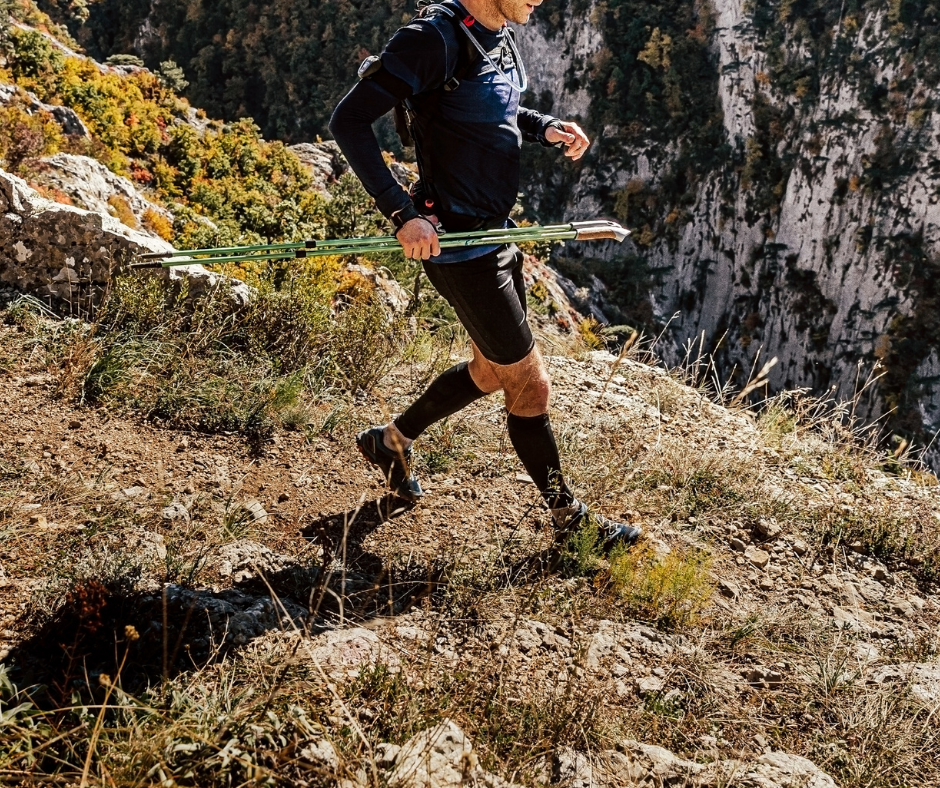
“The body cannot go from 0 to 100 just wanting it to happen” – Kilian Jornet
How to structure an uphill training session with elevation gain
To achieve real results, it is important to structure training sessions properly. Running uphill occasionally is not enough: specific sessions that simulate trail race conditions must be planned.
A well-structured uphill workout should include several phases, each with a specific purpose. Organizing training clearly helps manage effort intensity and makes the session more effective.
| Training Phase | Description |
|---|---|
| Warm-up | 15–20 minutes of easy running |
| Main climb | Continuous climb of 30–60 minutes |
| Intensity | Controlled aerobic pace |
| Recovery | Controlled downhill for active recovery |
| Cool-down | 10 minutes of slow running |
This structure allows the body to progressively prepare for the climb, maintain a sustainable effort during the main phase of training, and promote gradual recovery at the end of the session.
Training progression for long climbs
One of the most common mistakes among trail runners is increasing the duration of uphill training too quickly. Long ascents require gradual adaptation of both muscles and the cardiovascular system.
For this reason it is recommended to progressively increase the time spent climbing over the training weeks. This allows the body to develop endurance while reducing the risk of injuries.
A possible progression for elevation gain training can be organized gradually as follows:
| Week | Continuous Climb Duration |
|---|---|
| 1 | 30 minutes |
| 3 | 40 minutes |
| 5 | 50 minutes |
| 7 | 60 minutes |
| 9 | 75 minutes |
| 11 | 90 minutes |
This progression allows runners to gradually increase time spent climbing while improving muscular endurance and aerobic capacity without overloading the body too quickly.
Running technique on long climbs
Running technique becomes particularly important when tackling climbs with elevation gain. Inefficient posture can quickly increase energy consumption and lead to early fatigue.
Training technique during uphill sessions helps improve running efficiency and maintain a steady rhythm even on steep sections of the trail.
During uphill running it is useful to focus on some key technical elements:
-
maintain a short and frequent stride
-
lean the torso slightly forward
-
place the foot firmly on the ground
-
actively use the arms to support propulsion
-
maintain a steady breathing rhythm.
Over time these technical adjustments become automatic and allow runners to move more efficiently even on very long climbs.
When to run and when to walk uphill
One of the most important aspects of managing climbs in trail running is understanding when it is better to run and when it is more efficient to walk. Even the strongest trail runners frequently alternate between running and walking during long ascents.
This strategy helps conserve energy and maintain a sustainable pace for the entire race. Learning how to apply it during training is therefore essential.
A simple rule can help manage different slopes along the elevation profile:
-
slope under 10%: continuous running
-
slope between 10% and 20%: alternate running and walking
-
slope above 20%: power hiking.
Practicing this strategy during uphill training sessions helps runners arrive at races with much better effort management.
Common mistakes in uphill training
Many runners include uphill training in their routine but make mistakes that reduce its effectiveness or increase fatigue risk.
Understanding these mistakes can help improve training quality and make better use of sessions focused on elevation gain.
Among the most common uphill training mistakes we find:
-
starting too fast at the beginning of the climb
-
trying to run even on very steep slopes
-
not training downhill running after the climb
-
neglecting running technique
-
increasing training volume too quickly.
Avoiding these mistakes helps improve training quality and build stronger endurance for long climbs.
How to integrate climbs into your weekly training plan
Training climbs with elevation gain should be integrated into the weekly program in a balanced way. Too much elevation gain can lead to excessive fatigue, while too little will not develop the endurance needed for trail races.
The ideal frequency depends on the runner’s level and the distance of the race being prepared. In general, it is useful to alternate different types of workouts throughout the week.
| Training Type | Frequency / Description |
|---|---|
| Long climbs | One session every 10–14 days |
| Uphill intervals | One session of short high-intensity climbs |
| Long run with elevation | Long run on a route with moderate elevation gain |
| Easy runs | Low-intensity sessions for recovery |
This combination allows runners to work on different aspects of performance, progressively developing muscular strength, aerobic endurance, and the ability to manage routes with elevation gain.
If you have difficulty structuring an effective training plan, a certified trail running coach may help guide your preparation.
Preparing for races with significant elevation gain
The most demanding trail running races often include thousands of meters of elevation gain. Without specific preparation, these climbs can become the most critical part of the race.
Training regularly on climbs with elevation gain allows runners to tackle these courses with greater confidence and better control of effort.
Among the competitions that require specific preparation for long climbs we can find:
-
ultra trail races with high elevation gain such as Tor des Géants or UTMB
-
skyrunning races such as Elba Trail or Adamello Ultra Trail
-
trail races longer than 40 km such as Lavaredo Ultra Trail
-
mountain races with more than 2000 meters of elevation gain such as CCC and TDS.
Preparing for these events requires progressive training that includes long climbs, technical work, and proper intensity management.
Conclusion
Training climbs with elevation gain is one of the most effective ways to improve in trail running. Long climbs help develop muscular strength, aerobic endurance, and better effort management on mountain terrain.
Including this type of training in your weekly program allows you to prepare more completely for trail races, especially when elevation gain becomes a determining factor of the course.
With gradual progression, efficient technique, and intelligent effort management, climbs can transform from a difficult obstacle into one of the strongest aspects of your mountain running performance.
_ _ _ _ _ _
DO YOU WANT to try to follow a structured training plan with a Certified Coach? See our offer of personalized programs
DO YOU WANT to participate in one of our TRAIL Camps? See our TRM Trail Running Camps
WOULD YOU LIKE TO SPEAK TO ONE OF OUR COACHES? Book your appointment: info@trailrunningmovement.com
_ _ _ _ _ _
Frequently Asked Questions (FAQ)
1. How often should you train climbs with elevation gain?
Frequency depends on the athlete’s level and the race being prepared. In general, one specific long climb session every 10–14 days and one uphill interval session per week is recommended.
2. Is it better to run or walk during long climbs?
On long or steep climbs it is often more efficient to alternate running and walking. Many trail runners use power hiking on slopes steeper than 15–20% to conserve energy.
3. How long should a training climb be?
For beginners, a continuous climb of about 30 minutes is sufficient. With time it can gradually increase to 60–90 minutes to simulate long race climbs.
4. What is the ideal slope for uphill training?
Climbs with a gradient between 6% and 12% are ideal for continuous uphill running. Steeper slopes can be used for power hiking or strength workouts.
5. Do uphill workouts improve running on flat terrain?
Yes. Uphill training develops muscular strength and running efficiency, qualities that can translate into better performance even on flat terrain.
_ _ _ _ _ _
#trailrunning #ultratrail #trailtraining #uphilltraining #elevationgain #mountainrunning #runningtraining #trailrunner #trailrunningtraining #offroadrunning #runningperformance #runningtechnique #muscularendurance #racepacing #trailracestrategy #TRMRacePlan #TrailRunningCoach #TRMCoach #TRMTrainingPlan #TRM #TrailRunningMovement


allenatori trail running, long climb, trail running, trail running camps, trail running coaching, trail running plans, trail running programmes, train for ultra trails, train for uphill, ultra trail, ultra trail runner, uphill running training