

Stretching for trail running

Trail running stretching: the best exercises to improve performance (2026)

What kind of stretching should a trail runner do to improve joint, muscle, and tendon flexibility?
This is one of the most frequent questions we receive from the athletes we coach and from our TRM Community on social media.
We want to clear things up and address the many doubts shared by trail runners worldwide…
In this guide, we will explore a complete trail running stretching routine, analyzing 22 targeted exercises—an integral part of the TRM Method—that will allow you to:
• improve performance
• prevent injuries
• speed up recovery times.
Remember, stretching is a core part of your training and cannot be replaced or skipped due to a lack of time!
So, organize your schedule and include these exercises in almost every session.
Enjoy the read!
TRM Team
Why is stretching important in trail running?
Trail running requires an elastic and resilient body, capable of adapting to constant elevation changes and uneven terrain.
Integrating a specific stretching routine is not just a way to prevent injuries like tendonitis or muscle strains, but a real tool to optimize the mechanical efficiency of your stride.
Scientific evidence confirms the importance of a differentiated approach:
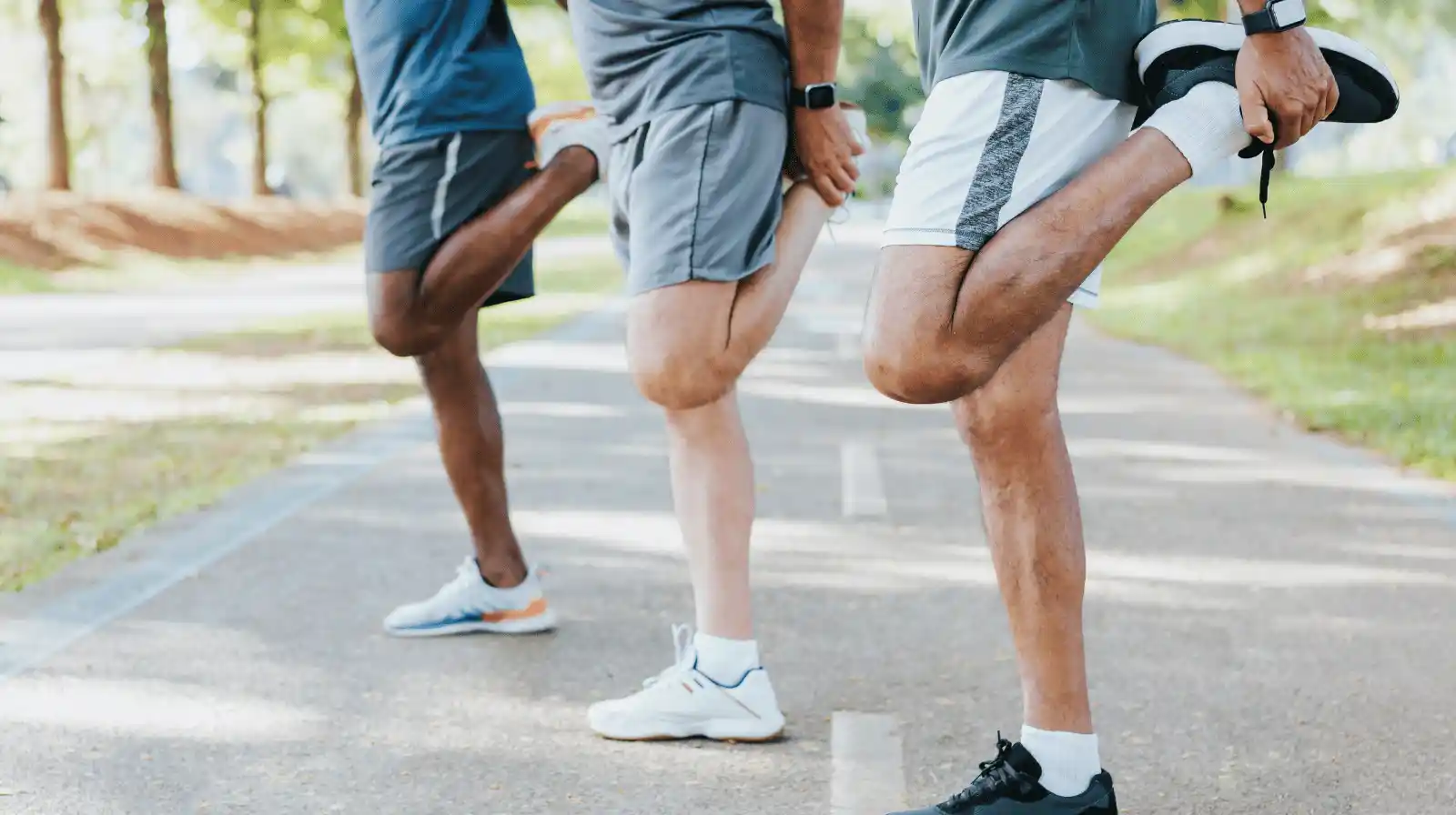
  • Dynamic stretching before running.
  • Static stretching during the recovery phase.
Before hitting the trails, it is essential to activate your muscles with dynamic stretching.
Exercises such as:
  • controlled leg swings (front and side),
  • ankle rotations,
  • and walking lunges
prepare the tendons for the eccentric stress typical of technical descents.
This phase:
  1. increases muscle temperature and
  2. improves proprioception, which is fundamental for
  3. avoiding sprains on roots and loose rocks.
After training, static stretching helps decontract the most stressed muscle chains.
Focus on:
  • stretching the hip flexors, often shortened by steep climbs,
  • and the calves, the main engine for positive vertical gain.
Maintaining stretching positions for the piriformis and gluteal muscles:
  1. promotes metabolite drainage and
  2. accelerates cellular turnover for faster recovery.
Remember never to force through pain: the stretch must be progressive and accompanied by deep, diaphragmatic breathing.
Consistently dedicating 15 minutes to these practices will transform your mobility, ensuring superior performance and a longer, trouble-free athletic career.
A correctly performed stretching session, ideally after easy training sessions (never after high-intensity workouts), helps return muscles to their optimal length and encourages toxin drainage.
Let’s look at the best trail running stretching sequence together.

Stretching n. 1: Standing Quad Stretch
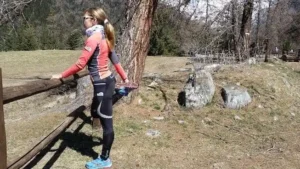
trail runner che fa stretching in montagnaThis first exercise focuses on one of the primary engines of uphill running: the quadriceps.
  • Purpose: used to decompress the anterior compartment of the thigh, often shortened after long technical descents.
  • Sets and Duration: 3 sets per leg, 30-second hold.
  • Muscles Involved: quadriceps femoris, rectus femoris, and iliopsoas.
  • Benefits: reduces patellar tension and improves hip extension.

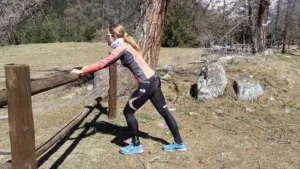
Stretching n. 2: Calf Stretch
trail runner fa lo stretching in montagna esercizio n. 2
Using a support like a fence, we focus on the upper part of the calf.
  • Purpose: fundamental for those who run a lot on their forefoot or tackle steep slopes.
  • Sets and Duration: 2 sets per side, 40-second hold.
  • Muscles Involved: gastrocnemius (calf).
  • Benefits: prevents plantar fasciitis and Achilles tendon inflammation.

Stretching n. 3: Soleus Stretch with Bent Knee
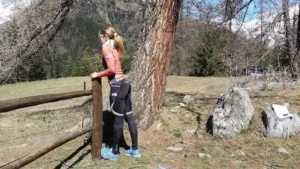
trail runner fa lo stretching in montagna esercizio n. 3
A variation of the previous one that shifts the work deeper.
  • Purpose: to isolate the soleus muscle by slightly bending the knee while the heel presses into the ground.
  • Sets and Duration: 2 sets per side, 30-second hold.
  • Muscles Involved: soleus.
  • Benefits: increases ankle mobility, essential on uneven terrain.

Stretching n. 4: Wide-Legged Standing Forward Fold
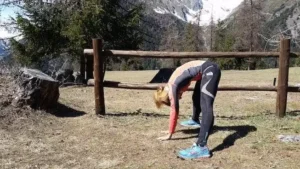
trail runner fa lo stretching in montagna esercizio n. 4
Starting to work on the posterior chain with a wide base of support.
  • Purpose: to simultaneously stretch the adductors and hamstrings.
  • Sets and Duration: 3 sets, 30-second hold.
  • Muscles Involved: hamstrings, adductors, lower back muscles.
  • Benefits: lower back relaxation and greater hip opening.

Stretching n. 5: Deep Fold with Ankle Grip
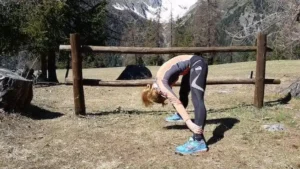
trail runner fa lo stretching in montagna esercizio n. 5
A more intense variation for those seeking maximum posterior stretching.
  • Purpose: bringing the torso towards straight legs to maximize tension on the posterior kinetic chain.
  • Sets and Duration: 2 sets, 30-second hold.
  • Muscles Involved: biceps femoris, semitendinosus, spinal erectors.
  • Benefits: improves overall spinal flexibility.

Stretching n. 6: Forward Fold with Feet Together
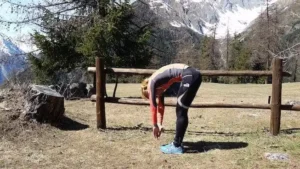
trail runner fa lo stretching in montagna esercizio n. 6
The classic “closing” position to test your mobility.
  • Purpose: to completely release tension accumulated along the entire back of the body.
  • Sets and Duration: 2 sets, 45-second hold.
  • Muscles Involved: hamstrings, calves, and lower back.
  • Benefits: promotes nervous system relaxation as well as muscular.

Stretching n. 7: Elevated Hamstring Stretch
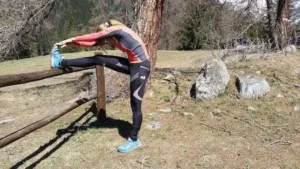
trail runner fa lo stretching in montagna esercizio n. 7
Using a fence, we isolate one leg at a time.
  • Purpose: allows for millimeter-precise control of the hamstring stretch while avoiding hip compensation.
  • Sets and Duration: 3 sets per leg, 30-second hold.
  • Muscles Involved: hamstrings (back of the thigh).
  • Benefits: prevents muscle tears and improves stride.

Stretching n. 8: Deep Lunge for Hip Flexors
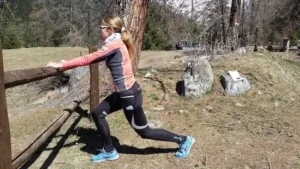
trail runner fa lo stretching in montagna esercizio n. 8
Image 8 shows a lunge performed with hand support.
  • Purpose: to stretch the psoas, a muscle that tends to shorten significantly in runners.
  • Sets and Duration: 3 sets per side, 30-second hold.
  • Muscles Involved: iliopsoas, rectus femoris.
  • Benefits: reduces post-run back pain and improves posture.

Stretching n. 9: Knees to Chest
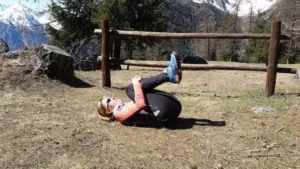
trail runner fa lo stretching in montagna esercizio n. 9
Moving to the floor phase for deeper recovery.
  • Purpose: to decompress the lumbar vertebrae after the impactful stress of running.
  • Sets and Duration: 2 sets, 60-second hold.
  • Muscles Involved: gluteus maximus, spinal erectors.
  • Benefits: immediate relief to the lower back.

Stretching n. 10: Lying Single Hamstring Stretch
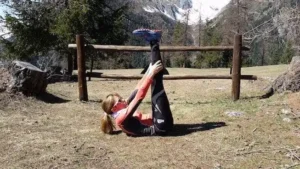
trail runner fa lo stretching in montagna esercizio n. 10
Supporting the leg with your hands for controlled work.
  • Purpose: to stretch the back of the thigh while eliminating spinal load.
  • Sets and Duration: 3 sets per leg, 30-second hold.
  • Muscles Involved: biceps femoris.
  • Benefits: ideal for those suffering from sciatic tension.

Stretching n. 11: Vertical Leg for Mobility
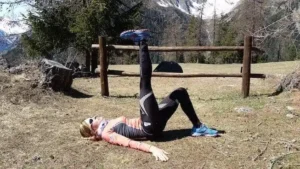
trail runner fa lo stretching in montagna esercizio n. 11
Similar to the previous one, but focused on active hold.
  • Purpose: to improve hip joint range of motion in a neutral position.
  • Sets and Duration: 2 sets per side, 30-second hold.
  • Muscles Involved: posterior chain and hip stabilizers.
  • Benefits: greater fluidity in the running movement.

Stretching n. 12: Butterfly Stretch
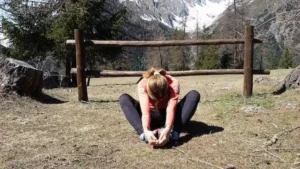
trail runner fa lo stretching in montagna esercizio n. 12
Sitting on the ground with the soles of the feet touching.
  • Purpose: to stretch the adductors and improve hip opening.
  • Sets and Duration: 3 sets, 40-second hold.
  • Muscles Involved: adductors (brevis, longus, magnus), gracilis.
  • Benefits: fundamental for managing sudden changes of direction in trail running.

Stretching n. 13: Butterfly Variant with Upright Torso
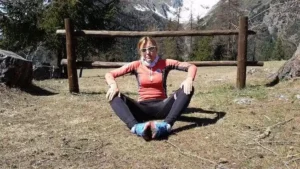
trail runner fa lo stretching in montagna esercizio n. 13
Maintaining the position while seeking spinal verticality.
  • Purpose: to combine hip opening with correct postural alignment.
  • Sets and Duration: 2 sets, 45-second hold.
  • Muscles Involved: adductors and postural trunk muscles.
  • Benefits: improves diaphragmatic breathing during stretching.

Stretching n. 14: Single Leg Fold
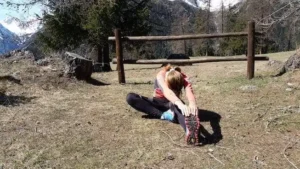
trail runner fa lo stretching in montagna esercizio n. 14
One leg is straight, the other is bent with the foot near the pelvis.
  • Purpose: to isolate the stretch of a single biceps femoris at a time.
  • Sets and Duration: 3 sets per side, 30-second hold.
  • Muscles Involved: hamstrings and contralateral lumbar fascia.
  • Benefits: corrects any muscle asymmetries between the legs.


Stretching n. 15: V-Sit Stretch
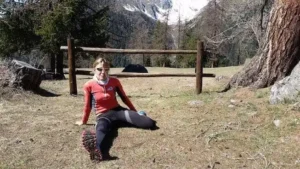
trail runner fa lo stretching in montagna esercizio n. 15
Both legs are straight and spread wide apart.
  • Purpose: to work intensely on global pelvic flexibility.
  • Sets and Duration: 2 sets, 40-second hold.
  • Muscles Involved: adductors, hamstrings, and lower back.
  • Benefits: increases the range of motion of the lower limbs, essential for technical trails.

Stretching n. 16: Seated Spinal Twist
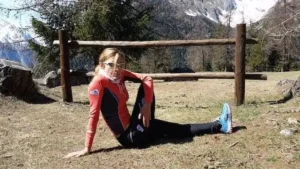
trail runner fa lo stretching in montagna esercizio n. 16
In a seated position, cross one leg over the other and rotate your torso.
  • Purpose: to release tension in the spine and the piriformis muscle.
  • Sets and Duration: 2 sets per side, 30-second hold.
  • Muscles Involved: piriformis, glutes, and obliques.
  • Benefits: improves torso rotation and reduces stiffness caused by carrying a running vest.

Stretching n. 17: Supine Spinal Twist
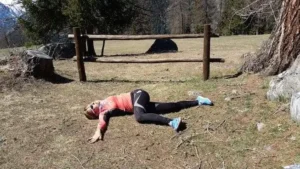
trail runner fa lo stretching in montagna esercizio n. 17
Performed lying on the ground for maximum relaxation.

• What it’s for: Using the weight of the bent leg to rotate the pelvis relative to the shoulders.
• Sets and duration: 2 sets per side, 45-second hold.
• Muscles involved: Quadratus lumborum, glutes, and pectorals.
• Benefits: Extremely effective for recovering the back after trails with significant elevation gain.

Stretching n. 18: Standing Lateral Trunk Flexion
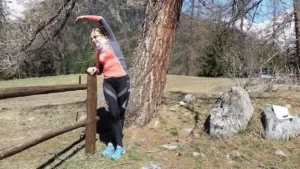
trail runner fa lo stretching in montagna esercizio n. 18
Use a support to stabilize the position.

• What it’s for: Stretching the entire lateral fascia of the body.
• Sets and duration: 3 sets per side, 20-second hold.
• Muscles involved: Obliques, intercostals, and tensor fasciae latae.
• Benefits: Improves rib cage expansion and breathing.

Stretching n. 19: Upward Axial Extension
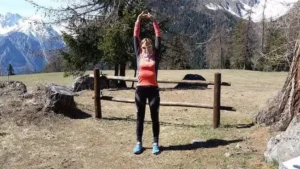
trail runner fa lo stretching in montagna esercizio n. 19
Hands interlaced and pushed toward the sky.

• What it’s for: Re-aligning the spine after hours of running in often contracted positions.
• Sets and duration: 2 sets, 20-second hold.
• Muscles involved: Latissimus dorsi, shoulder muscles.
• Benefits: A sensation of lightness and postural “opening.

Stretching n. 20: Overhead Tricep Stretch
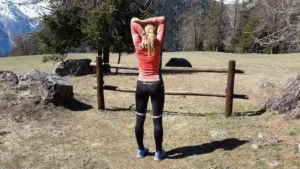
trail runner fa lo stretching in montagna esercizio n. 20
Bring one arm behind the head, pushing the elbow downward.

• What it’s for: Releasing tension in the arms, heavily used for balance and with poles.
• Sets and duration: 2 sets per arm, 20-second hold.
• Muscles involved: Triceps brachii.
• Benefits: Prevents stiffness in the upper limbs

Stretching n. 21: Shoulder and Arm Variant
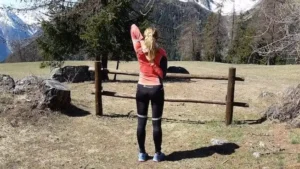
trail runner fa lo stretching in montagna esercizio n. 21
Further emphasis on scapulohumeral mobility.

• What it’s for: Ensuring that shoulders remain low and relaxed during the run.
• Sets and duration: 2 sets per side, 20-second hold.
• Muscles involved: Deltoids, triceps.
• Benefits: Reduces neck and trapezius pain caused by carrying a trail backpack.

Stretching n. 22: Pectoral Stretch Against a Tree
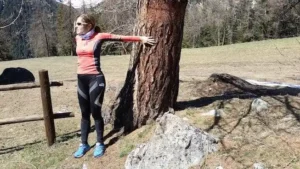
trail runner fa lo stretching in montagna esercizio n. 22Conclude the sequence by opening the chest using a natural element.

• What it’s for: Counteracting the forward rounding of the shoulders (kyphotic posture) typical of fatigue.
• Sets and duration: 3 sets per side, 30-second hold.
• Muscles involved: Pectoralis major and minor.
• Benefits: Optimizes lung capacity and improves running form.

Conclusions for Perfect Trail Running Stretching

Integrating this trail running stretching routine into your training plan will make the difference between a constantly injured runner and a long-lived athlete.
Remember to never force through pain.
Stretching should be a pleasant sensation of tension.
Perform these movements in a quiet environment, as shown in the splendid mountain settings of the sources, to combine physical well-being with mental relaxation.
Happy trails and happy stretching!
_ _ _ _ _. _
#stretching #staticstretching #trailrunningstretching #runstretching #stretchingroutine #trailrunningrecovery #trailmobility #posttrailstretching #trailinjuryprevention #trailrunnerflexibility #trailstretchingexercises #trailrunninglengthening #trailmusclerecovery #injuryprevention #trailrunningtraining #trailrunningcoach #runningcoach #trailrunningcommunity #trailrunninglife #mobility #recovery #trailrunningtips #trailrunningcoach #trmteam #trmcoach #trailrunningmovement #trailrunning
_ _ _ _ _ _

Frequently Asked Questions (FAQ)

When is it best to stretch for trail running: before or after the run?
It is advisable to perform static stretching after training during non-strenuous sessions, such as fat-burning runs or short-distance long runs, when the muscles are warm.
Before a run, dynamic warm-up is preferable to activate the muscles without reducing their reactivity.
How much time should I dedicate to post-trail stretching?
A complete trail running stretching session takes about 5-15 minutes.
Each exercise should be held for 20-30 seconds, repeated 2-3 times per side, without ever forcing to the point of reaching the pain threshold.
Which muscles are most stressed in trail running and need stretching?

The priority muscle groups are:

  • quadriceps,
  • calves (gastrocnemius and soleus),
  • hamstrings,
  • hip flexors (iliopsoas),
  • adductors,
  • back muscles.
Shoulders and pectorals also benefit from stretching for those who use trail running poles.
Does stretching help prevent trail running injuries?
Yes, it is fundamental!

A regular stretching routine improves muscle-tendon elasticity, reduces asymmetrical tensions, and promotes recovery, decreasing the risk of:

  • plantar fasciitis,
  • tendinitis,
  • contractures,
  • strains,

and many other common problems for trail runners.

Can I stretch if I already have an injury?
In the case of an acute injury, always consult a physiotherapist before stretching the injured area.
During the recovery phase, gentle and targeted stretching can be useful, but only under specialist supervision.
It is best if the initial stretches are shared with a physiotherapist to verify the state of muscles, tendons, and joints.
Which exercises are most suitable for those who run a lot downhill?
Technical descents place heavy eccentric stress on the quadriceps.
Therefore, the most useful exercises are:
  • standing quadriceps stretch,
  • forward fold with feet together, and
  • hamstring stretch on an elevated support to balance the posterior chain.
Is it normal to feel pain during stretching?
No. Stretching should cause a pleasant sensation of tension, never acute pain or sharp stabs.
If you feel pain, reduce the intensity or stop the exercise: forcing it can cause micro-lesions.
How often should I stretch if I run 3-4 times a week?
Ideally, you should perform a stretching session every training day.
At the end of training for low-load workouts.
In the case of quality sessions, between the warm-up and the strenuous part: intervals, fartlek, or progression runs.
In these cases, the stretching session is shorter to prevent the muscles from cooling down too much before the main session.
An athlete focused on achieving peak sports performance could include a full stretching routine once a week on a rest or recovery day.
Even simple, short 5-10 minute sessions on active rest days promote recovery.
Can I stretch in the morning or evening, regardless of my workout?
Yes, light mobility and stretching sessions can be useful even at times separate from training, especially in the evening to promote muscle relaxation and sleep quality.
Which errors should be avoided in stretching for trail runners?
The most common mistakes are:
  • stretching with cold muscles,
  • bouncing during the hold,
  • holding your breath,
  • ignoring asymmetries between limbs,
  • rushing the execution.
Consistency and correct technique are worth more than intensity.
Article written April 2026

allenatori trail running, Metodo allenamento TRM, Muscle stretching, muscles stretching, stretching, stretching exercises, trail runner stretching, Trail Running Programs, trail running stretching, TRM, TRM Coach, TRMTrainingPlan, ultra trail coach
Marco Mori

E' Preparatore Atletico e Allenatore di Trail Running con Certificazione SNaQ CONI dal 2014. Collabora come Presidente di TRM Team ASD, collabora come allenatore di atleti di trail running, formatore nei corsi per allenatori di trail running. E’, tutt'oggi, l'unico preparatore atletico italiano ad aver gareggiato sulla distanza di 900km, in tappa unica: Transpyrenea 900K (10° Assoluto Maschile).  Conta oltre 100 competizioni ultra trail internazionali e numerosi podi di categoria. E' autore di ricerche di mercato e articoli su allenamento, strategie di gara, infortuni e materiali sportivi per il trail running e running in italiano e inglese. Direttore Sviluppo Strategico, dopo aver praticato vari sport a livello agonistico ha scoperto la sua particolare predisposizione per le competizioni estreme e le endurance ultra trail che riesce a coniugare con la vita professionale.