


Ultra trail training mix: how to build a truly effective training programme
Preparing for an ultra trail does not simply mean increasing weekly mileage. This is one of the most common beliefs—and also one of the most limiting.
The reality is that performance in long-distance running comes from the balance between different training stimuli, integrated in an intelligent way. It is precisely this “mix” that determines the quality of ultra trail preparation, far more than volume alone.
Training properly for trail running means having a precise plan that takes into account:
- the time of year
- your personal characteristics
- your level and your goals.
Without these foundations, it becomes difficult to develop specific qualities, improve performance and maintain a stable level of fitness.
In this article, we will look at how to structure the ultra trail training mix, in order to best prepare for competitions and trail running races.
Enjoy the reading
_ _ _ _ _ _
_ _ _ _ _ _
What the “ultra trail training mix” really means
When talking about a training mix for ultra trail, we are not referring to a simple sum of different sessions, but to an integrated system in which each component has a precise function and contributes to the others.
The goal is not to do “everything,” but to do the right things in the right way and at the right time.
An effective mix comes from the awareness that each type of training stimulates specific adaptations, but it is the interaction between these adaptations that generates overall improvement.
Key components of the mix
Before going into practical details, it is useful to clarify the pillars on which a complete ultra trail preparation should be built:
- easy long run → develops aerobic endurance and fat utilization as fuel
- strength training → improves muscular efficiency and reduces injury risk
- intensity workouts → raise thresholds and improve effort management
- running technique → increases efficiency and safety on technical terrain.
These elements should not be considered separately. The long run becomes more effective when supported by strength work, technique improves when the body is resilient, and intensity is only sustainable on a solid aerobic base.
It is precisely this interdependence that makes the mix a strategic tool.

Balancing training stimuli in the preparation phase
Before looking at individual sessions in detail, it is essential to clarify a often overlooked principle: training for ultra trail requires a precise plan based on:
- the time of year
- individual characteristics
- level and goals.
During the preparation phase, one of the most effective approaches is to distribute training load in a clear way, prioritizing the aerobic base without neglecting other energy systems.
This allows the athlete to build a solid and long-lasting condition, avoiding imbalances.
Example of training load distribution
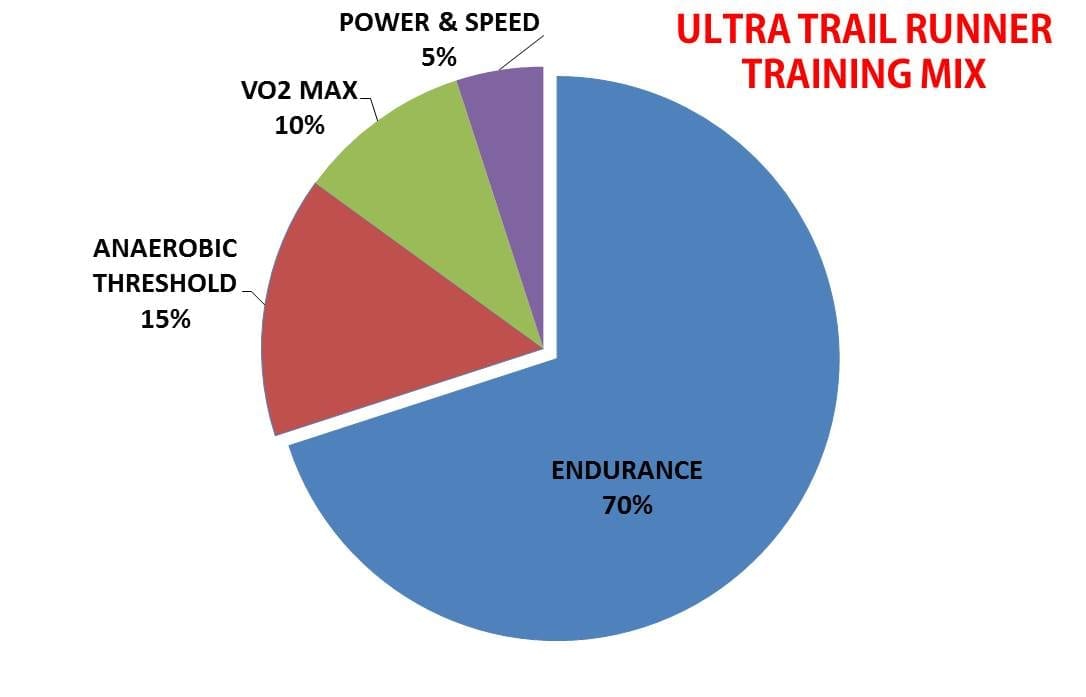
To make this approach more concrete, here is an example of a balanced training mix for an ultra runner:
- 70% endurance (intensity < 80% of maximum heart rate)
- 15% anaerobic threshold (efforts lasting between 20 minutes and 1 hour)
- 10% VO2 max (intervals between 3 and 10 minutes)
- 5% high intensity (very short efforts < 2 minutes, focused on strength and speed).
This distribution highlights a key principle: most of the work should remain at low intensity, building an aerobic base on which more specific stimuli can be added.
At the same time, high-intensity components, although smaller in volume, are essential to complete performance development.

How to apply the ultra trail training mix to a weekly plan
Once the training components and their distribution are defined, the crucial step is translating everything into a coherent weekly structure.
This is where theory meets practice: without this connection, even the best model remains abstract.
Training for an ultra trail does not simply mean inserting different sessions into the week, but building a logical sequence in which each workout has a specific function.
The balance between endurance, threshold, VO2 max, and high-intensity work must emerge from the real distribution of training loads.
Basic principles for combining training
Before looking at a practical example, it is useful to establish some guidelines that help maintain balance and progression over time:
- alternate intense sessions and recovery
- avoid overlapping similar training loads
- place strength work at the most appropriate moments
- progressively build long run volume.
These principles help structure the week, preventing unproductive fatigue accumulation and maintaining high training quality.
Real distribution of training stimuli
Looking at a typical week, it is possible to connect the training mix percentages to real practice:
- endurance (70%) → easy runs, long weekend run, medium effort run
- anaerobic threshold (15%) → controlled quality sessions
- VO2 max (10%) → high-intensity intervals, usually within quality sessions
- high intensity (5%) → short strength and speed work.
This distribution should not be interpreted rigidly on a daily basis, but rather over a weekly or multi-week cycle. What matters most is consistency over time.
Example of a weekly plan
To make these concepts operational, here is a possible weekly structure reflecting the ultra trail training mix described:
| Day | Training | Main goal |
|---|---|---|
| Monday | Recovery / light activity | Regeneration and adaptation |
| Tuesday | Intensity (hills/threshold/VO2) | Advanced aerobic development |
| Wednesday | Easy run + technique | Running economy |
| Thursday | Strength | Muscular efficiency |
| Friday | Easy run or rest | Active recovery |
| Saturday | Trail long run | Endurance |
| Sunday | Medium run | Consolidation |
This weekly plan is flexible and can be adapted based on the athlete’s level and training phase.
Its value lies in the logic it represents: each session contributes to the overall mix, creating an integrated and progressive system.
Common mistakes in training mix design
When it comes to ultra trail preparation, it is not uncommon to see motivated and consistent athletes underperforming. In most cases, the issue is not the amount of training, but how it is structured.
Often, the balance between different components is lost, with too much focus on what seems most intuitive—such as simply running more—while neglecting other essential aspects.
The result is an unbalanced mix that may seem effective in the short term but reveals its limitations over time.
To build a truly solid preparation, it is useful to recognize and correct some recurring mistakes:
- focusing almost exclusively on volume, assuming “more is better”
- neglecting strength training, considering it secondary
- avoiding quality workouts due to fear of fatigue or injury
- always training on easy terrain, not representative of race conditions
- never simulating real fatigue conditions.
These mistakes share a common root: a partial view of training. Correcting them means starting to think in terms of a system, where each element has a precise role and contributes to the final result.
If you want to avoid these mistakes in your preparation, you can rely on a Trail Running Coach who, thanks to their experience, can guide you in combining training elements and stimuli to achieve the best possible results.

The role of strength in ultra trail preparation
Among all the elements of the training mix, strength is probably the most underestimated, especially by those coming from road running. Yet in trail running—and even more so in ultra trail—it represents a fundamental component.
Strength is not only about “pushing harder,” but about making running more efficient, stabilizing the body on technical terrain and reducing stress on muscles and joints. In other words, it is what allows you to maintain quality even when fatigue increases.
Integrating strength into the weekly routine does not mean overhauling your training, but rather adding targeted stimuli consistently:
- bodyweight exercises such as squats, lunges and core work
- specific uphill strength training
- short but regular sessions, one or two times per week.
The most important aspect is not the complexity of the exercises, but their consistency over time. Even simple interventions, if applied regularly, can make a significant difference, especially when hours and elevation gain accumulate.
Technique and specificity
Before reaching the conclusion, it is worth focusing on an aspect that is often taken for granted in ultra trail preparation:running technique. In ultra trail, being able to perform the running gesture efficiently on variable terrain is a huge advantage.
It is not just about running “well” in an aesthetic sense, but about adapting to the terrain, saving energy, and moving safely. Good technique allows you to handle descents, climbs and technical sections with greater control, also reducing the risk of mistakes.
Technique is built over time, through experience and attention to detail. To develop it, it is useful to:
- run regularly on technical trails
- specifically train downhill running
- include agility and coordination drills.
These elements help make running more natural and efficient, especially in the later stages of a race, when fatigue tends to compromise movement quality.
Working on technique therefore means bringing training increasingly closer to the real conditions of ultra trail running.

Conclusion: building a system, not a list
The real breakthrough in ultra trail preparation does not come from increasing volume, but from improving the integration between training elements.
The ultra trail training mix is not a checklist of things to do, but a system to be carefully built, adapted over time and personalized. Percentages, weekly structure, and individual sessions are tools: what truly makes the difference is the ability to connect them into a coherent whole.
Only when you stop thinking in compartments and start thinking in terms of systems does training become truly effective. And it is precisely in this shift that a solid, sustainable, and performance-oriented preparation is built.
_ _ _ _ _ _
Want to understand how to apply these concepts in a concrete and personalized way?
Discover our TRM Training Plans and get a structured program
designed specifically for you by TRM Coaches and based on the exclusive TRM Method
adapted to your level, goals, and race calendar
_ _ _ _ _ _
Frequently Asked Questions (FAQ)
1. Do I really need to follow precise training percentages?
Percentages are a useful reference, not a strict rule. They help you understand whether you are overemphasizing one type of stimulus, but they should always be adapted to your level, the period, and how you feel.
2. Can I still improve by only running?
To a certain extent, yes, but you will eventually reach a plateau. Without strength, technique, and quality workouts, your training will remain incomplete and less effective in the long term.
3. How long should a long run be for an ultra trail?
It depends on the race distance and your experience, but it is not only about duration. Elevation, terrain, and fatigue management are equally important factors.
4. Are intensity workouts risky for ultra trail runners?
If correctly integrated, they are essential. The risk comes when they are done too often or without an adequate aerobic base. In the right balance, they significantly improve performance.
5. Is it better to train more days or do longer sessions?
It depends on your available time, but in general, it is more effective to distribute training across more days, maintaining quality and consistency.
6. How can I tell if my ultra trail training mix is correct?
If you recover well, gradually feel stronger, and manage fatigue better during long runs, you are likely on the right track. If you feel constantly tired or “flat,” something needs adjustment.
7. Should strength training be done year-round?
Yes, although with different volume and intensity. It plays a more important role in the preparation phase but remains essential throughout the season.
_ _ _ _ _ _
#trailrunning #ultratrail #trailrunningtraining #runningtips #endurancetraining #trailrunner #ultrarunninglife #strengthtraining #runningtechnique #athletictraining #endurance #runningcommunity #trailruntraining #outdoorrunning #ultramarathon #trainingplan #sportendurance #trailrunningitalia #runningcoach #ultratrailtraining #TRMTrainingPlan #TRMTeam #TRM

endurance trail running, TeamTRM, trail running coaching, trail running plans, training for ultra trails, trainining for trail running