


The best ultra trail running shoes for 2026
Ultra trail running is a discipline that challenges both body and mind over extreme distances, generally ranging from 45 to 167 km, often on highly variable terrain and with elevation gains exceeding 3,000–10,000 meters of D+.
In this context, choosing the best ultra trail running shoes for 2026 is not just a matter of buying gear, but a strategic decision that directly affects performance, safety, fatigue management, and the likelihood of reaching the finish line.
In recent years, the trail running shoe market has evolved significantly. By 2026, we are seeing a generation of models designed specifically for ultra trail racing, featuring technical solutions aimed at supporting athletes for many hours of continuous running, often in challenging environmental conditions.
This article has one clear goal:
to provide a technical, authoritative, and independent guide to help ultra runners consciously choose the shoe best suited to their characteristics, race distance, and usage context—without spending excessive amounts of money.
_ _ _ _ _ _
What “Ultra Trail” Really Means: 45–167 km
In common usage, any trail race longer than a marathon is often referred to as an “ultra trail.
From a technical and performance standpoint, however, distances between 45 and 167 km—although they are among the most sought-after challenges for trail runners—represent very different scenarios, requiring different approaches, including shoe selection.
In this article, we focus on distances over 45 km, because beyond this threshold numerous physical issues and discomforts begin to arise.
Choosing the right shoe therefore makes a decisive difference in how the race is experienced and in the potential injuries that may occur during or after the competition.
Do not choose shoes based on aesthetics or because they are recommended by a friend or a shop assistant (especially one who does not run trail). Make your decision using your own judgment and objective data.
We can identify three main distance categories that influence shoe choice.
Short Ultra Trails (45–80 km)
-
average duration: 4–15 hours
-
relatively high intensity
-
often technical but still “runnable” terrain
-
medium to high muscular and joint stress.
Medium Ultra Trails (80–120 km)
-
average duration: 8–20 hours
-
significant neuromuscular fatigue accumulation
-
progressive foot swelling
-
long and repeated descents.
Long Ultra Trails (120–167 km)
-
average duration: 15–30 hours
-
fatigue management as a key factor
-
loss of biomechanical efficiency
-
high risk of blisters, overload injuries, and microtrauma.
A shoe suitable for a 50 km race is not automatically appropriate for 100 km or 167 km distances, even if it belongs to the same “trail” category.
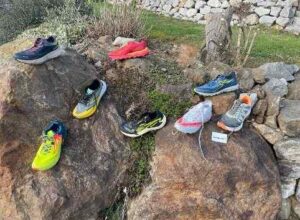
Why Ultra Trail Shoes Are Different from Traditional Trail Shoes
Shoes designed for “classic” trail running are not built to handle:
-
repeated loads for more than 8–10 hours
-
deterioration of running technique
-
volumetric changes in the foot
-
the need for long-lasting comfort over time
The best ultra trail shoes must meet specific requirements:
-
long-lasting cushioning that does not collapse after dozens of kilometers
-
longitudinal and torsional stability to compensate for reduced motor control
-
plantar protection against rocks, roots, and abrasive descents
-
reliable grip, especially on wet rock and mixed terrain
-
tolerant fit, capable of adapting to a foot that changes over time
In 2026, the best ultra trail models integrate advanced solutions such as:
-
reinforcements in multiple areas of the upper
-
high-resilience foams
-
advanced rocker geometries (sole curvature)
-
improved internal comfort
-
plates or stabilizing inserts
-
quick-lacing systems
-
high-friction outsoles.
Advanced Selection Criteria for Ultra Trail Shoes 2026
Choosing the best ultra trail shoe does not mean buying the most expensive or heavily marketed model.
It means evaluating a combination of technical factors, always in relation to the athlete and the type of race.
Cushioning and Stack Height
For distances over 60–70 km, a medium-to-high level of cushioning becomes essential to:
-
reduce muscular impact
-
preserve neuromuscular freshness
-
improve long-term running economy
In 2026, most effective ultra trail shoes feature:
-
a high—but controlled—stack height (foot-to-ground distance)
-
reactive compounds that are not excessively soft
Drop and Biomechanics
Drop affects:
-
load on calves and Achilles tendon
-
downhill posture
-
fatigue management capacity
There is no universally “best” drop, but:
-
4–6 mm drop represents a good compromise for many ultra runners
-
zero drop requires progressive adaptation and low-gradient terrain
-
higher drops favor comfort and protection over very long distances.
Fit and Internal Volume
During an ultra trail race, the foot tends to:
-
swell
-
lose precision in ground contact
-
increase skin sensitivity.
For this reason, the most effective ultra trail shoes in 2026 offer:
-
a wider forefoot
-
structured but non-rigid uppers
-
a good balance between containment and tolerance.
Outsole and Grip
Grip is a safety factor, not just a performance feature.
The best outsoles for ultra trail must guarantee:
-
traction on both dry and wet rock
-
reliability on mud and unstable terrain
-
durability beyond 300–450 real kilometers.
Technical comparison table: best ultra trail shoes 2026
The following table summarises the 18 shoes selected, one per brand, all tested for use on ultra trails between 45 km and 167 km.
| model | ideal distance | cushioning | stability | grip | forefoot space | ideal terrain | athlete profile |
|---|---|---|---|---|---|---|---|
| hoka speedgoat 6 | 60–167 km | high | high | very high | medium | alpine, technical mixed | versatile ultra runner |
| la sportiva prodigio pro | 60–120 km | medium | very high | very high | medium | technical alpine | experienced technical runner |
| saucony peregrine 16 | 45–90 km | medium | medium | high | medio-stretto | running technician | lightweight fast runner |
| brooks caldera 8 | 60–167 km | very high | high | medium-high | large | runable, mixed | runner seeking protection |
| salomon s/lab ultra glide | 80–167 km | very high | high | high | medium-large | mixed alpine | ultra long-distance runner |
| new balance hierro v9 | 50–100 km | high | medium | high | medium-large | mixed, not very technical | comfort-oriented runner |
| asics trabuco max 3 | 60–167 km | very high | high | medium-high | medium | runable, mixed | heavy runner / protection |
| adidas terrex agravic flow 2 | 45–90 km | medium | medium | high | medium | compact mixture | efficient runner |
| scarpa golden gate | 60–120 km | medium | very high | high | medium | rocky alpine terrain | technical runner |
| nnormal tomir carbon 2 | 45–100 km | medium-high | medium | high | medium | fast mixed | competitive advanced runner |
| the north face vectiv infinite | 50–120 km | high | high | high | medium | mixed, trail | experienced intermediate runner |
| nike ultrafly 2 | 45–100 km | medium-high | medium | high | medium | technical runnable | powerful and fast runner |
| altra lone peak 9 | 60–167 km | medium | medium | high | very large | long mixed | runner accustomed to zero drop |
| inov-8 trailtalon 300 | 45–90 km | medium | high | very high | medium | mud, technical | runner seeking extreme grip |
| topo ultraventure 4 | 60–120 km | high | high | medium-high | large | mixed long | runner comfort + stability |
| on cloudultra pro | 60–167 km | high | high | medium-high | medium | runable long | regular and efficient runner |
| merrell agility peak 5 | 60–167 km | high | high | medium-high | medium | mixed long | sturdy runner |
| arc’teryx norvan ld 4 | 60–167 km | medium-high | high | high | medium | technical alpine | durable technical runner |
Hoka Speedgoat 6
Ultra trail 60–167 km. Balance between protection and versatility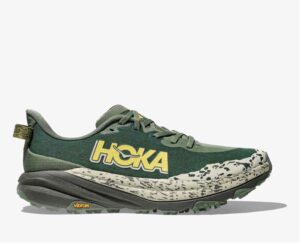
The Speedgoat 6 represents one of the most advanced balances between cushioning, stability, and grip in the 2026 ultra trail landscape.
The high-stack midsole effectively protects the muscles after many hours of running, while the Vibram Megagrip outsole with deep lugs ensures reliable traction even on wet rock and unstable terrain.
Recommended for:
-
alpine and mixed ultra trails
-
80–167 km races
-
athletes looking for long-term protection and reliability
As we write, the Hoka Speedgoat 7 has hit the market. Its main upgrades over the Speedgoat 6 focus on improved comfort and responsiveness.
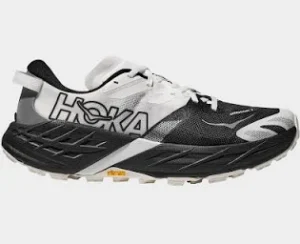
Here is a summary of the key differences:
- Midsole: Upgraded to Supercritical Foam (SCF). It is softer, bouncier, and more responsive compared to the stiffer CMEVA foam used in version 6.
- Weight: Lighter (approx. 272g vs. 283g for the Speedgoat 6).
- Comfort: Key issues from the previous model have been fixed, featuring a longer, padded tongue and a more protective heel collar.
- Traction: It retains the 5mm Vibram Megagrip, but with a new lug orientation for safer braking during descents.
- Fit: A slightly wider base and the addition of gaiter attachments.
In short: the Speedgoat 7 is more cushioned, lighter, and more comfortable.
La Sportiva Prodigio Pro
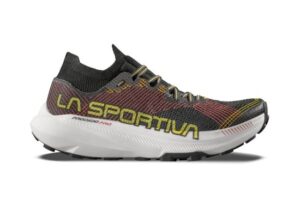 The Prodigio Pro is designed with a clearly mountain-oriented approach.
Compared to more cushioned models, it prioritizes precision, lateral stability, and downhill control, making it particularly effective on technical alpine terrain.
Recommended for:
-
highly technical trails
-
efficient runners with good muscular strength
-
ultra trails up to 100–120 km
Saucony Peregrine 16
Ultra trail 45–100 km, aggressive and responsive
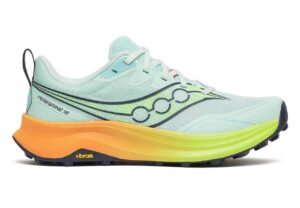
The Peregrine 16 maintains a compact and dynamic setup, ideal for short to medium ultra trails where intensity remains high.
The PWRTRAC grip performs well across different terrains, while the lower profile enhances responsiveness and precision.
Recommended for:
-
45–80 km ultras
-
light and fast runners
-
technical but runnable courses
Brooks Caldera 8
Ultra trail 50–167 km, maximum muscular protection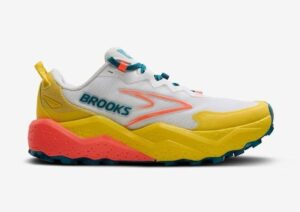
The Caldera 8 is designed to preserve muscular freshness over very long distances.
Generous cushioning reduces joint impact, while the wide platform increases stability as running mechanics deteriorate with fatigue.
Recommended for:
-
long, runnable ultra trails
-
athletes sensitive to muscular impact
-
races lasting over 10–12 hours
Salomon S/LAB ULTRA GLIDE
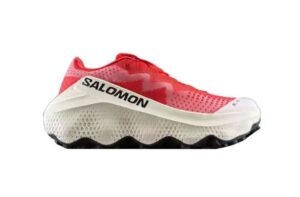
The Salomon S/LAB Ultra Glide represents an evolution of Salomon’s ultra trail concept, with a stronger focus on long-term comfort compared to the more race-oriented traditional S/LAB models.
The high-volume midsole uses a highly resilient compound that maintains consistent cushioning even after many hours of use, reducing muscular impact and preserving neuromuscular freshness in the final stages of the race.
The pronounced rocker geometry promotes smooth transitions when running form degrades due to fatigue.
The platform is more stable and tolerant than previous S/LAB models—an essential feature beyond 10–12 hours of effort.
The wraparound upper with Quicklace ensures precise lockdown without pressure points, while the roomy forefoot accommodates natural foot swelling during very long races.
The durable Contagrip outsole offers a solid compromise between traction on dry rock, mixed terrain, and compact trails, making the shoe suitable for variable alpine environments.
Recommended for:
-
80–167 km ultra trails
-
trail runners prioritizing long-term protection and comfort
-
long and very long races on mixed terrain
-
athletes looking for a more cushioned Salomon compared to traditional S/LAB models
New Balance Hierro v9
Ultra trail 45–100 km, comfort and protection
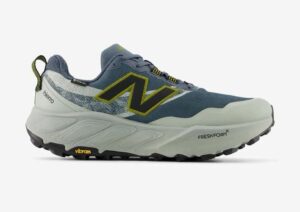 The Hierro v9 is a solid, well-cushioned shoe designed for long trails that are not extremely technical.
Recommended for:
-
short to medium ultra trails
-
runners seeking comfort
-
mixed terrain
ASICS Trabuco Max 3
Ultra trail 50–167 km, maximum cushioning
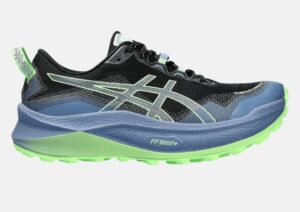 The Trabuco Max 3 is one of the most protective shoes in the category.
Ideal for runners who struggle with impact over very long distances.
Recommended for:
-
long ultra trails
-
heavier runners
-
muscular fatigue management.
Adidas Terrex Agravic Flow 2
Mixed ultra trail 45–100 km
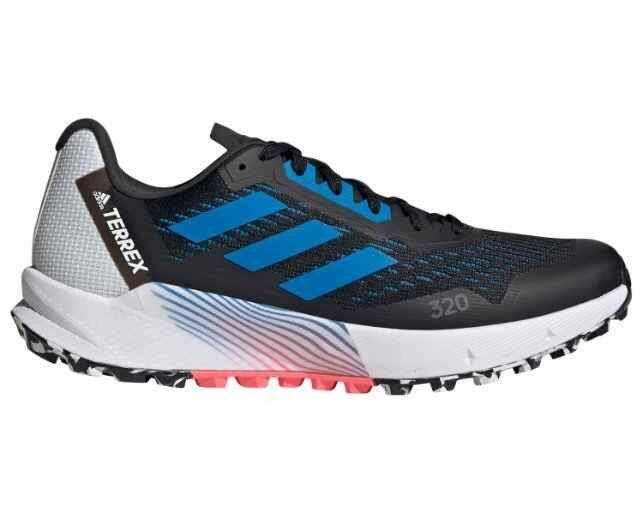 The Agravic Flow 2 stands out thanks to its Continental outsole, reliable on both dry and wet surfaces.
It is a well-balanced shoe for runnable trails.
Recommended for:
-
short ultras
-
mixed courses
-
efficient runners.
Scarpa Golden Gate
Technical ultra trail 50–120 km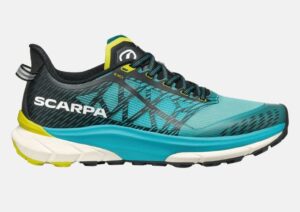
The Golden Gate is among the best ultra trail shoes offering structure, stability, and reliability on alpine terrain.
A solid choice for true mountain running.
Recommended for:
-
technical trails
-
alpine ultra trails
-
experienced runners.
NNormal Tomir Carbon 2
Ultra trail racing 45–100 km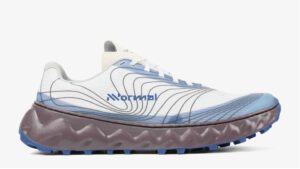
The Tomir Carbon 2 integrates a carbon plate to increase responsiveness and efficiency.
It is a highly performance-oriented shoe that requires adequate preparation.
Recommended for:
-
fast ultra trails
-
advanced runners
-
competitive races.
The North Face Vectiv Infinite
Ultra trail 45–120 km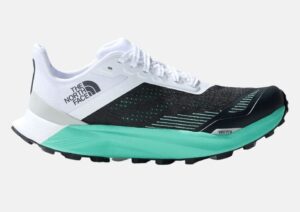
The Vectiv Infinite offers a strong balance of stability and protection, making it suitable for medium-distance ultra trails.
Recommended for:
-
long trails
-
variable terrain
-
medium-weight runners.
Nike Ultrafly 2
Fast ultra trail 45–100 km
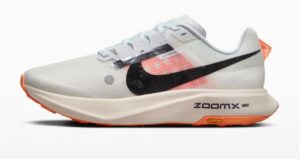 The Ultrafly 2 is a technologically advanced shoe with a stiff and highly reactive setup.
Not a universal model, but in the right hands it delivers excellent performance on short to medium ultras.
Recommended for:
-
fast trails
-
powerful runners
-
highly runnable races.
Altra Lone Peak 9
Ultra trail 45–167 km, zero drop
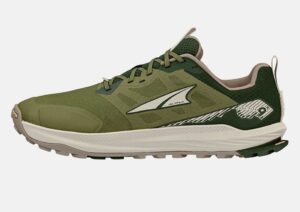 The Lone Peak 9 is one of the most widely used ultra trail running shoes for long races, thanks to its zero drop and extremely wide toe box.
It promotes natural biomechanics and reduces the risk of toenail and forefoot issues.
Recommended for:
-
very long ultra trails
-
runners adapted to zero drop
-
those seeking maximum forefoot comfort.
Inov-8 TrailTalon 300
Muddy and technical ultra trail 45–100 km
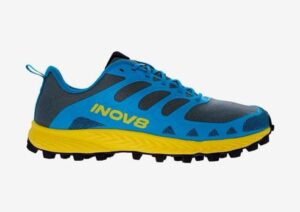 The TrailTalon 300 stands out for its graphene-infused outsole, offering exceptional durability and grip.
An excellent choice for harsh conditions, mud, and unstable terrain.
Recommended for:
-
muddy trails
-
highly technical courses
-
runners who prioritize grip.
Topo Ultraventure 4
Ultra trail 50–120 km, natural and stable
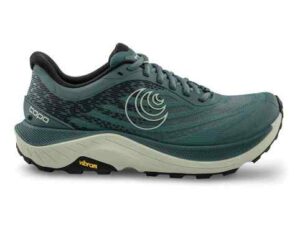 The Ultraventure 4 delivers an excellent balance of comfort, stability, and forefoot freedom.
A well-rounded option for runners seeking reliability without extremes.
Recommended for:
-
medium-distance ultra trails
-
mixed terrain
-
medium-weight athletes.
On Cloudultra Pro
Ultra trail 45–167 km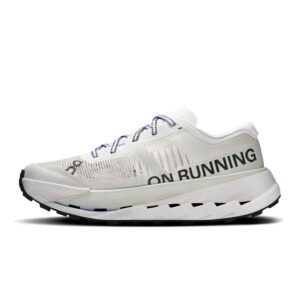
The Cloudultra Pro focuses on stability and controlled geometry.
It is particularly effective on runnable trails where stride consistency is key.
Recommended for:
-
long ultra trails
-
non-extreme terrain
-
efficient runners.
Merrell Agility Peak 5
Ultra trail 50–167 km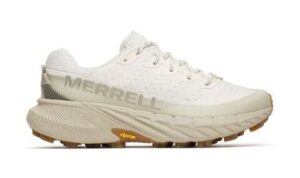
The Agility Peak 5 emphasizes comfort and durability.
A good choice for very long ultras that are not highly technical.
Recommended for:
-
long ultra trails
-
robust runners
-
mixed terrain.
Arc’teryx Norvan LD 4
Long ultra trail 45–167 km
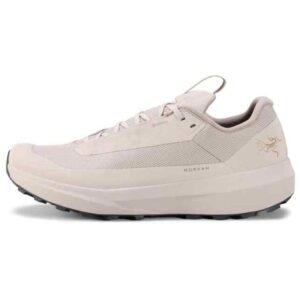 The Norvan LD 4 prioritizes precision and control while maintaining a lightweight yet durable structure.
Recommended for:
-
long ultra trails
-
technical terrain
-
runners with strong running technique.
How to properly integrate training and ultra trail running shoes
One of the most common beliefs in trail running is that choosing the “right” shoe can compensate for gaps in preparation.
In reality, in ultra trail distances from 45 to 167 km, the shoe acts as an amplifier—not a substitute—of the work done in training.
A suitable shoe:
-
supports biomechanics
-
reduces joint load
-
improves fatigue management
But only if it is integrated within:
-
a correct load progression
-
adequate muscle–tendon adaptation
-
a coherent race strategy.
The most common mistake among ultra runners
The main mistakes observed among amateur ultra runners are:
-
buying highly cushioned shoes
-
using them only on race day
-
training mostly with different models.
This approach creates biomechanical discontinuity, which often emerges after 6–8 hours of racing, when technique deteriorates and the muscles are not adapted to that specific mechanical response.
In the ultra trail context, the shoe must be:
-
an integral part of the training cycle
-
tested during progressive long runs
-
used in race-simulation workouts.

Relationship between race distance and shoe choice
One of the key aspects in choosing the best ultra trail running shoes for 2026 is the target race distance.
Requirements change significantly when moving from a 50 km race to a 100 km or 167 km ultra.
Shoes for 45–80 km ultra trails
Balance between protection and responsiveness
In this distance range:
-
intensity remains relatively high
-
total exposure time is more limited
-
running mechanics remain more efficient
Key shoe characteristics:
-
medium or medium–high cushioning
-
good energy return
-
relatively low weight
-
effective grip on technical terrain
Recommended training:
-
long runs of 25–35 km using race shoes
-
specific strength work uphill and downhill
-
race-pace simulations
In this context, an overly protective shoe may become a drawback in terms of dynamics and control.
Shoes for 80–100 km ultra trails
This is the distance range where true limits begin to emerge:
-
muscular
-
joint-related
-
neuromuscular.
The shoe must help the athlete to:
-
maintain efficient mechanics
-
reduce cumulative impact
-
preserve downhill stability.
Key characteristics of the best ultra trail shoes:
-
more generous cushioning
-
a stable platform
-
a tolerant fit
-
a durable outsole.
Recommended training:
-
back-to-back long runs
-
systematic use of race shoes
-
nutrition testing and foot-management.
In this range, the shoe becomes a true race-management tool, not just a means of locomotion.
Shoes for 120–167 km ultra trails
Beyond 120 km, ultra trail running enters a completely different dimension:
-
movement efficiency declines
-
mental fatigue affects technical decisions
-
the foot changes shape and sensitivity.
Key characteristics of ultra trail running shoes:
-
high, long-lasting cushioning
-
maximum longitudinal stability
-
wide forefoot
-
comfort that does not degrade over time.
Recommended training:
-
very progressive adaptation cycles
-
long runs lasting more than 5–6 hours
-
specific eccentric strength work
-
full testing of equipment and foot management.
In this scenario, the shoe should not “push,” but support.

Shoes and preparation for an ultra trail race
Footwear selection must go hand in hand with the training program.
In long-distance trail running, there is no real separation between:
-
shoe choice
-
training planning
The best ultra trail running shoes:
-
require progressive adaptation
-
must be integrated into the weekly training load
-
should be tested in conditions similar to race day.
Without this process:
-
injury risk increases
-
fatigue management worsens
-
the effectiveness of the shoe itself decreases.
This choice becomes especially important if you are preparing for:
-
a 45–80 km ultra trail
-
a 100 km race
-
iconic events such as UTMB, Lavaredo Ultra Trail, Tor des Géants or major European alpine ultras.
_ _ _ _ _ _
Choosing the right shoe is only part of the journey
👉 Trail Running Movement develops specific training programs for ultra trail runners, based on:
real race experience
advanced endurance methodology
integration of training, strength work, and race strategy
individual athlete adaptation.
Choose to train with a method, choose the guarantee of results, and become a Finisher of the most iconic ultra races in the world!
_ _ _ _ _ _
Frequently Asked Questions (FAQ)
What is the difference between trail shoes and ultra trail shoes?
Ultra trail shoes are designed to withstand many hours of continuous running. They offer greater cushioning, increased stability, and a more tolerant fit to manage foot swelling compared to traditional trail shoes.
How much cushioning is needed for an ultra trail?
For distances over 60–70 km, medium-high to high cushioning is recommended. It helps reduce muscular load and preserve freshness during the final stages of the race.
Is it better to choose a lighter or a more protective shoe for an ultra?
It depends on the distance. Below 80 km, lightness and responsiveness can be prioritized. Beyond 100 km, protection and stability become more important.
Why does the foot swell during an ultra trail?
After many hours of effort, fluid retention and micro-inflammation of the tissues increase. This is why a shoe with a wider forefoot and a non-compressive upper is necessary.
What drop is recommended for an ultra trail?
There is no universal drop. The 4–6 mm range represents a good compromise between protection and natural movement. Zero-drop shoes require progressive adaptation.
How important is grip in ultra trail shoes?
Grip is essential for safety. Over long distances, fatigue reduces foot placement precision, so a reliable outsole on rock and mixed terrain reduces the risk of slipping.
Is a highly cushioned shoe always the best choice?
Not always. If too soft, it can reduce stability on technical terrain. The key is finding the right balance between protection and control.
How often should ultra trail shoes be replaced?
Generally between 500 and 800 km, depending on the athlete’s weight, terrain, and shoe model.
Foam compounds lose shock-absorbing capacity even if the outsole still appears intact.
Can I use a brand-new shoe directly in a race?
No. An ultra trail shoe must be tested during long training runs to allow muscles and tendons to adapt to its mechanical response.
Why does stability become more important over long distances?
As fatigue increases, running technique deteriorates. A stable platform helps compensate for the loss of neuromuscular control.
Do I need different shoes for a 50 km and a 100 km race?
Often, yes. For a 50 km race, a more dynamic model can be used. For a 100 km race, a more protective and comfortable shoe is preferable.
Are carbon-plated shoes suitable for ultra trail running?
They can improve efficiency on runnable terrain, but they require good technique and well-adapted musculature.
They are not ideal for highly technical terrain.
How important is the upper in an ultra trail shoe?
Very important. It must hold the foot securely without compressing it, protect against debris, and adapt to progressive foot swelling.
What does a “forgiving” shoe mean?
It means a shoe that helps the athlete when fatigue sets in: more cushioning, greater stability, and a smoother stride transition.
Is it better to choose shoes based on the race or on running style?
Both. The shoe must suit the race characteristics, but above all it must match the athlete’s biomechanics and experience.
_ _ _ _ _ _
#TrailRunning #UltraTrail #TrailRunningShoes #UltraTrailRunning #BestTrailShoes #UltraTrailShoes2026 #TrailRunningItaly #RunningEndurance #TrailTraining #UltraMarathon #MountainRunning #TrailRunningMovement #TRM #TRMTrainingPlan
_ _ _ _ _ _
Bibliographic Sources
-
Direct experience and case studies from Trail Running Movement on alpine ultra trail races
-
iRunFar – trail shoe reviews and field testing on 100 km+ distances
-
RunRepeat – laboratory analysis of cushioning, stability, and grip
-
Runnea.it – model comparisons and use in European ultra trail races
-
UTMB World Series – technical data on distances, elevation gain, and average times
-
Scientific literature on endurance running biomechanics


best running shoes, best trail running shoes, best trail running shoes, CorsaInMontagna, EndurancetrailTraining, tips trail running shoes, trail runner life, trail running shoes, trail running shoes, Trail Running Training, trail running training, training for an ultra trail, TRM, Ultra Trail Running, ultra trail shoes