


How to read an elevation profile and prepare for trail races
In trail running, it’s not just about distance: it’s about terrain, elevation gain, effort distribution and above all, the ability to anticipate what the course will demand by reading the elevation profile.
Understanding how to read it means transforming a line on a graph into:
- a concrete strategy
- a targeted training plan
- conscious energy management on race day.
Many trail runners look at total mileage and total elevation gain and stop there. In reality, the elevation profile is the true emotional and physiological map of the race: it tells you where you will suffer, where you can breathe, where you’ll need patience, and where you can push.
Learning how to read an elevation profile is a skill that distinguishes those who endure the race from those who interpret it.
_ _ _ _ _ _
_ _ _ _ _ _
What an elevation profile is and what it represents
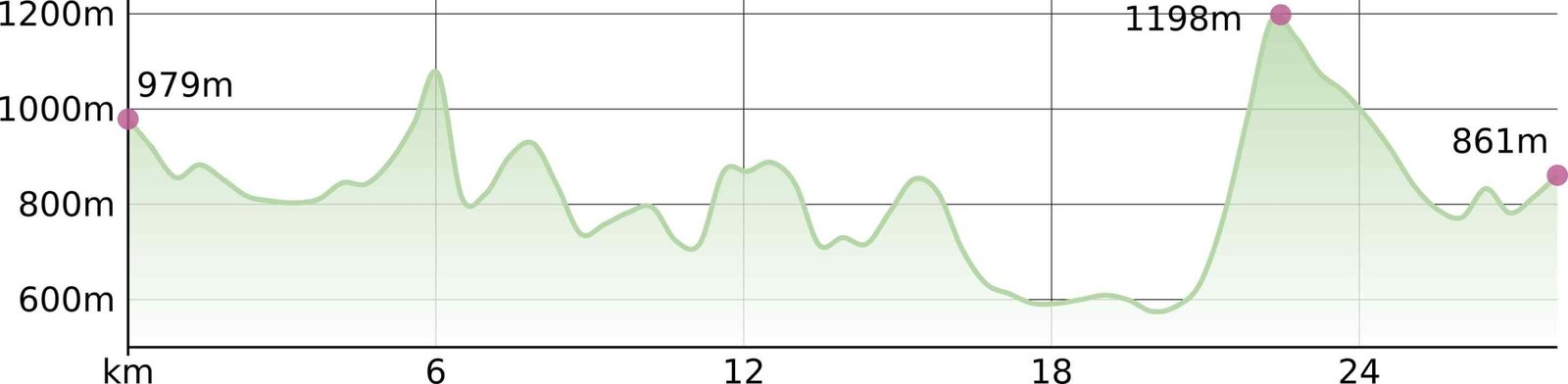
Before diving into strategy, it’s essential to clarify what we’re looking at. An elevation profile is a graphical representation of altitude changes along the race course.
It’s a visual summary that condenses kilometers, elevation gain, and gradient variations into a single glance.
Understanding how to read an elevation profile means correctly interpreting its components, avoiding misjudgments that could compromise preparation and performance.
In the graph, you’ll find several key elements:
- horizontal axis (X)
- vertical axis (Y)
- positive elevation gain (D+) and negative elevation loss (D−)
- average gradient and slope variations.
The horizontal axis represents the course distance. It’s the timeline of your effort: it tells you when you’ll encounter a climb, how long it will last, and where it sits within the race.
It also helps you mentally visualize where you’ll be, in terms of energy, when facing each segment.
The vertical axis indicates altitude. It’s important to remember that the scale may be “compressed” or “stretched,” visually exaggerating or minimizing slopes. That’s why anyone who truly wants to learn how to read an elevation profile must develop a critical eye and not be misled by the graphic representation.
Positive elevation gain (D+) indicates the total meters climbed, while negative elevation loss (D−) represents total descent.
What matters is not just the final number, but its distribution: one thousand meters concentrated in a single climb is very different from one thousand meters divided into short, repeated ramps.
Finally, the average gradient doesn’t tell the whole story. A climb may average 10% but alternate between 5% sections and 18% walls.
Being able to analyze these variations is central to understanding how to read an elevation profile in a truly strategic way.

Key elements to analyze before a race
Once you understand the technical basics, the next step is qualitative course analysis.
It’s not enough to observe the graph—you must interpret it correctly.
Learning how to read an elevation profile means turning it into a forecast of the muscular, cardiovascular, and mental effort that awaits you.
Distribution of climbs
Before evaluating anything else, focus on the climbs, as they are often the decisive factor in managing a trail race.
Specifically, distinguish between:
-
long, steady climbs
-
short, very steep ramps
-
runnable sections vs. hiking sections.
Long, steady climbs require endurance strength and the ability to maintain a consistent rhythm. If the elevation profile shows an 8–10 km continuous ascent, preparation should include prolonged aerobic threshold efforts.
Short, steep ramps impose intensity changes and place greater stress on the muscles. Here, power and pacing management become decisive.
Finally, distinguishing between runnable climbs and hiking sections is essential. Understanding how to read an elevation profile also means imagining where power hiking will be more efficient than insisting on running.
Type of descents
Descents are often underestimated but are a decisive component of trail running.
From the elevation profile, we can identify:
-
runnable, flowing descents
-
technical descents
-
very steep descents.
Runnable descents allow you to regain speed and sometimes recover energy.
Technical descents require focus, coordination and eccentric strength.
Very steep descents can compromise muscular durability if not properly prepared.
Those who know how to read an elevation profile don’t just look at how much they climb—they carefully analyze how and how much they descend.
Overall course rhythm
Not all trail races have the same “personality.” Some are linear, while others are extremely demanding and “nervous.”
When studying an elevation profile, it’s useful to assess:
-
continuous alternation of climbs and descents
-
presence of long runnable sections
-
potential final “walls”.
A nervous course requires constant pace changes and strong adaptability. A course with a final wall demands conservative energy management early on.
Understanding how to read an elevation profile also means grasping the overall rhythm of the course and distributing energy accordingly.

From elevation profile to training plan
Knowing how to read an elevation profile allows you to build a specific training plan, avoiding generic preparation that doesn’t reflect the real demands of the race.
A trail running coach can help you structure a training plan suited to your level and the race ahead, optimizing resources and workload to reach the start line in the best physical and mental condition.
Based on what emerges from the graph, training can focus on:
-
long climbs → endurance strength work and uphill intervals
-
technical descents → eccentric training and downhill technique
-
nervous courses → hilly fartlek and pace variations.
If the race features long ascents, you’ll need sustained uphill sessions simulating expected duration and intensity.
With demanding descents, you must prepare muscles to handle repeated eccentric loads, reducing the risk of breakdown.
For irregular and dynamic courses, variable-pace training improves adaptability.
In this way, reading an elevation profile becomes the key to truly targeted and high-performing training.
Example of a training plan based on profile
The following table correlates the characteristics of the route with physiological objectives and the most effective types of training.
| Elevation Profile Characteristic | Primary Physiological Impact | Training Objective | Examples of Specific Workouts |
|---|---|---|---|
| Long steady climbs (20–60 min) | Prolonged aerobic stress, progressive fatigue accumulation | Development of muscular endurance and aerobic threshold | Long uphill intervals, continuous steady-pace climbs, progressive uphill runs |
| Repeated short, steep climbs | Intensity peaks, strong muscular activation | Improvement of power and recovery capacity | Short uphill repeats (1–3 min), hill sprints, hilly fartlek |
| “Punchy” course with constant changes | Frequent fluctuations in pace and intensity | Metabolic adaptability and pace management | Mixed-terrain fartlek, variable hill circuits |
| Long, runnable descents | Prolonged eccentric stress on quadriceps | Downhill muscular endurance | Controlled descents at race pace, combined uphill–downhill sessions |
| Technical and steep descents | High neuromuscular and coordinative demand | Technique, stability, and control | Technical trail sessions, balance drills, core stability exercises |
| Final “wall” in the last kilometers | Accumulated fatigue + high mental demand | Ability to push hard under fatigue | Workouts finishing with an uphill segment, weekend back-to-back sessions |
Common mistakes when reading an elevation profile
Even experienced trail runners can make evaluation errors, as experience does not replace careful analysis.
The most frequent mistakes include:
-
looking only at total distance
-
focusing exclusively on D+
-
underestimating descents
-
ignoring effort distribution.
Limiting analysis to distance leads to misleading comparisons with road races, while considering only total elevation gain says nothing about its placement.
Descents, if ignored, can become the real limiting factor, and neglecting effort distribution exposes you to avoidable crises.
Anyone who truly wants to learn how to read an elevation profile must develop a complete and integrated perspective.
Race strategy: using the profile as a competitive advantage
As you’ve likely understood, the elevation profile is not just a graph—it’s a guide for planning race strategy.
Knowing the course structure in advance allows you to mentally divide it into segments and determine:
-
where to fuel
-
where to slow down
-
where to accelerate.
Understanding how to read an elevation profile means starting with awareness: avoiding being carried away by early enthusiasm, preserving energy before a long climb, tackling a technical descent with clarity, and reaching the final section with both physical and mental reserves.

Conclusion: interpret the terrain before you run it
Trail running is not just about endurance—it’s also about planning and adaptation.
Learning how to read an elevation profile means transforming a static graph into a dynamic story of effort, training specifically, preventing mistakes, and approaching the race with a real competitive advantage.
Those who interpret the elevation profile run with greater awareness—and in trail running, awareness often makes the difference between merely surviving a race and experiencing it as a protagonist.
_ _ _ _ _ _
Would you like more advice on training and race strategies?
Discover TRM services to become a Finisher:
or stay up to date by reading the articles on the Trail Running Movement Blog
_ _ _ _ _ _
Frequently Asked Questions (FAQ)



altitude profile, athletic training, CorsaInMontagna, Downhill Running, mountain running, running on technical grounds, trail running race strategy, trail runner, trail running plan, trail running programs, trail running race strategy, Training Endurance Races, uphill running